
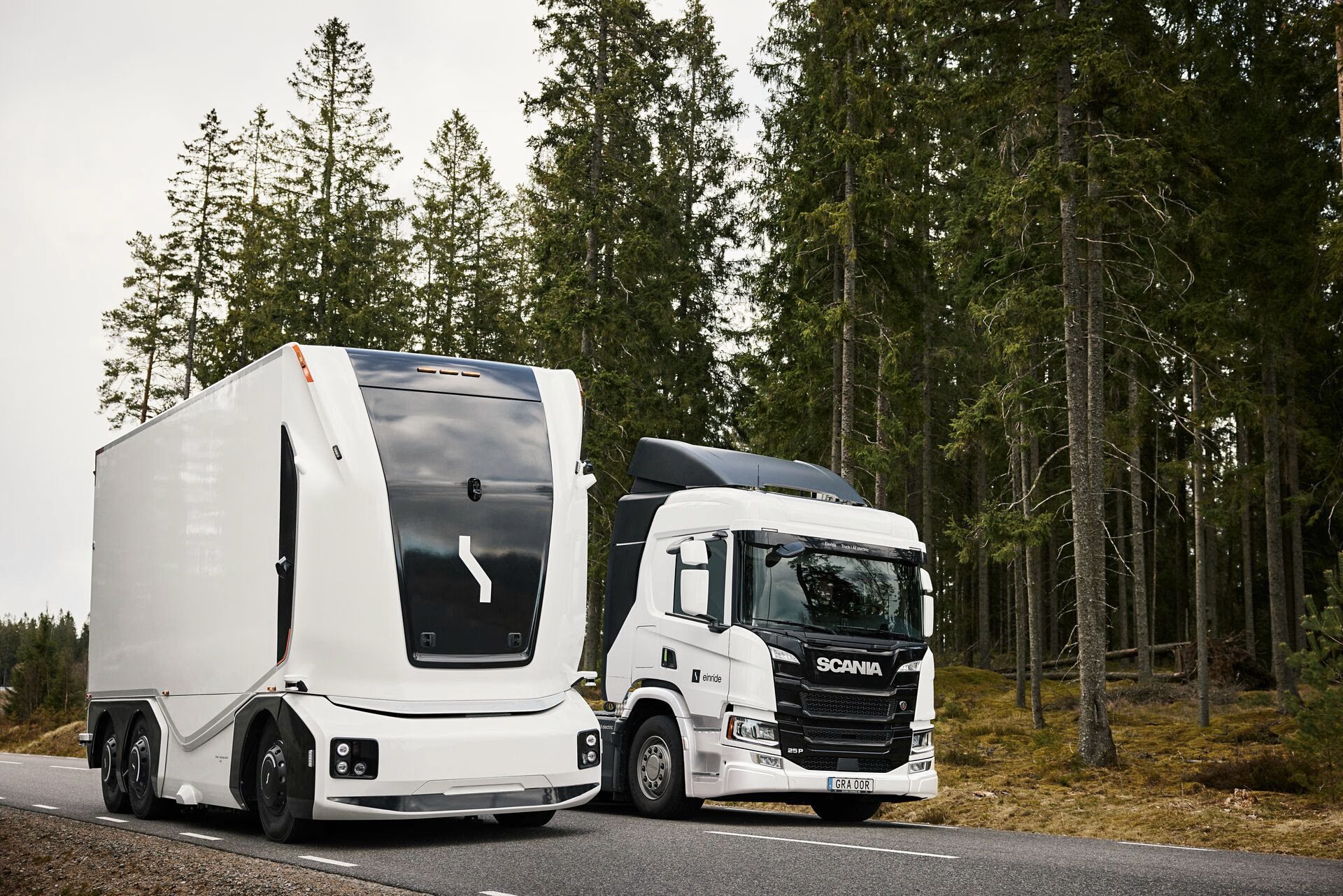
Einride Wins a Global Recognition Award 2026
Inside an Amazon Relay freight hub, 75 electric trucks pull out on schedule, no drivers, no diesel, no routing spreadsheets. Saga AI has already calculated the optimal charge window for each vehicle, sequenced the loads, and dispatched the fleet for the day’s 3 million annual electric miles target, all without a single human instruction. This is not a pilot program; it is Einride’s Freight-as-a-Service platform running live within one of the world’s largest logistics networks. For building the only full-stack autonomous electric freight system that has achieved SAE Level 4 approval on public roads across two continents, maintained a zero traffic incident record, and delivered a doubling revenue trajectory with global enterprise clients, Einride has earned a 2026 Global Recognition Award. The Stockholm-founded company, now valued at $1.35 billion ahead of a planned US public listing, has validated a thesis that sustainable freight requires reimagining the truck itself, not merely electrifying or automating the one that already exists.
Technical Innovation and Architecture
Einride‘s central architectural decision — removing the driver’s cab entirely — is not a design aesthetic. It is an engineering stance that changes every downstream technical and commercial calculation. Without a cab, the vehicle can be optimized exclusively for freight: aerodynamics improve, cargo volume increases, manufacturing complexity decreases, and the full-system redundancy required for autonomous operation can be engineered from the ground up rather than retrofitted around human occupancy requirements. The Einride Driver, the company’s proprietary autonomous drive stack, processes millions of sensor data points per second from an integrated suite of lidars, cameras, and antennas — a perception architecture built specifically for heavy-duty freight environments rather than adapted from passenger vehicle autonomous systems.
Saga AI operates as the intelligence layer above the hardware: a real-time operating system that coordinates vehicle dispatch, route optimization, charging schedule management, load sequencing, and fleet-wide performance monitoring from a centralized data platform. The system achieves 97% operational uptime across all autonomous deployments. It supports a human-in-the-loop Control Tower model where expert operators oversee autonomous fleets simultaneously, with a single operator able to monitor two trucks concurrently as of 2025. This air-traffic-control approach to autonomous fleet management provides both the safety oversight that regulators require and the labor-efficiency ratio that makes autonomous freight economically viable at a commercial scale. The Einride Autonomous Driver is also designed as a dual-use modular platform, integrable across vehicle types for defense and industrial applications beyond commercial trucking.
Market Strategy and Leadership
CEO and Founder Robert Falck spent seven years at Volvo Group, reaching Director of Powertrain Manufacturing Engineering, before founding Einride in 2016. His direct experience with the structural limits of conventional truck design gave Einride’s founding decision — to build a purpose-designed cabless vehicle rather than adapt an existing platform — a level of technical conviction that no software-first autonomous competitor has matched. Co-founders Linnéa Kornehed Falck and Filip Lilja contributed complementary operational and strategic depth, and the team executed against a Freight-as-a-Service commercial model that packages vehicles, charging infrastructure, Saga AI software, and remote fleet operations into a single managed service contract, removing the capital and operational barriers that slow enterprise fleet electrification.
With $702.16 million raised across 17 rounds, including a $100 million round in October 2025 at a $1B+ valuation and a $113 million PIPE in February 2026 ahead of a planned US SPAC listing, Einride has built a capital structure that funds simultaneous fleet scaling, hardware development, and geographic expansion without forcing trade-offs between near-term revenue and long-term autonomy investment. Net sales more than doubled in 2024; geographic expansion into Austria and the UAE was completed that year, and the April 2026 Amazon partnership — 75 trucks, five charging sites, Saga AI managing the full operational layer — represents the largest single enterprise deployment in the company’s history. Investors EQT Ventures and Northzone lead a 29-investor base that includes both financial and strategic partners aligned with the long-horizon timeline of autonomous freight commercialization.
Industry Impact and Future Vision
Road freight moves approximately 70% of all goods transported in the United States and accounts for roughly 7% of global CO₂ emissions — a sector that is simultaneously economically essential and environmentally costly. Einride’s enterprise clients span consumer goods (PepsiCo, Heineken, Mars, Carlsberg), retail (Lidl), industrial manufacturing (GE Appliances, Philips), and global logistics (DP World, Amazon), confirming that the freight decarbonization problem is not sector-specific but universal across every supply chain that depends on road transport. The September 2025 world-first cabless autonomous border crossing between Sweden and Norway validated cross-border freight autonomy under EU customs and regulatory frameworks, opening the commercial pathway for the 45% of EU freight that crosses national borders to transition to autonomous operation. Every autonomous mile driven by an Einride vehicle feeds operational data back into Saga AI, compounding the system’s route, charging, and dispatch optimization over time.
Einride’s roadmap scales the autonomous fleet across North America and Europe, pursues the US public listing to access capital markets for fleet acceleration, and develops the dual-use Einride Autonomous Driver platform for defense and government vehicle integration. This market vertical adds durable, long-term contract revenue to the commercial freight base. The zero-incident autonomous safety record, validated by independent third-party audits, positions Einride as the benchmark against which every future autonomous freight regulatory approval process globally will be measured. For building a freight platform that simultaneously eliminates diesel emissions, replaces structural driver shortages with intelligent autonomous systems, and delivers operational reliability at 97% uptime with a flawless safety record across live commercial deployments on two continents, Einride has fully earned the distinction of the 2026 Global Recognition Award.
Luminous model family trained entirely on German infrastructure across five European languages, reaching 300 billion parameters in its largest variant.
Proprietary T-Free tokenizer eliminates BPE fragmentation penalties for European languages, delivering performance advantages in multilingual processing that US-built LLMs cannot replicate at training time.
PhariaAI full-stack platform provides GDPR-native, classified-information-ready AI deployment with full output traceability for every model decision.
Built-in explainability layer surfaces source documents and reasoning chains behind AI outputs, meeting EU AI Act transparency requirements at the architecture level.
Pharia-1 LLM-7B released as open-source under Apache 2.0 license, enabling developer community adoption while protecting enterprise deployment revenue.
All training, inference, and deployment infrastructure operates within German data centers, subject exclusively to German and EU law with no CLOUD Act exposure.
$636.55 million raised across multiple funding rounds from strategic industrial investors, including Bosch, SAP, Schwarz Group, HPE, and Earlybird Venture Capital.
Series B of $500 million closed in November 2023, co-led by Schwarz Group, Innovation Park Artificial Intelligence (IPAI), and Bosch Ventures.
Active production deployments across German federal ministries, the Bundeswehr, and Schwarz Group enterprise ecosystem — the most demanding compliance environments in European enterprise AI.
Post-Series B valuation of approximately €2.7 billion ($3 billion), establishing Aleph Alpha as Germany’s highest-valued AI company.
Pharia Government Assistant deployed across multiple German public sector bodies, automating document processing, regulatory research, and administrative knowledge workflows.
April 2026 planned acquisition by Cohere values the combined entity at approximately $20 billion, with Schwarz Group committing $600 million as Series E lead investor.
Combined Cohere-Aleph Alpha entity backed by both the Canadian and German federal governments, creating the only transatlantic sovereign AI platform with G7 government support.
Dual headquarters structure in Toronto and Germany positions the merged entity for simultaneous North American and European enterprise procurement.
Distribution agreement with Schwarz Group’s STACKIT cloud platform provides deployment access into one of Europe’s largest retail and logistics operator ecosystems.
Founder Jonas Andrulis’s Apple AI background and co-founder Samuel Weinbach’s Deloitte enterprise strategy experience provide dual-track technical and commercial leadership.
Only German-origin foundation model company with classified-information clearance for active Bundeswehr and federal ministry deployments.
PennyLane’s Python-first, hardware-agnostic design allows quantum developers to write once and deploy across multiple quantum hardware vendors without platform lock-in.
Amazon Braket integration provides enterprise developers cloud-managed access to Xanadu’s quantum hardware through AWS’s established enterprise infrastructure.
PennyLane and Catalyst integration with the Munich Quantum Toolkit (MQT) from the Technical University of Munich, extending academic and enterprise usability across European research institutions.
Multiverse Computing partnership enables financial services clients to build quantum applications for risk modeling and market forecasting using PennyLane as the core programming layer.
Cloud-based access to quantum processors removes the need for on-premise quantum hardware deployment, enabling enterprise and research users to access photonic computing without capital hardware investment.
All infrastructure operates exclusively within German data centers under EU energy and environmental standards, with no dependence on US hyperscale cloud providers whose energy sourcing is less transparent.
Founding mission explicitly frames AI development as a societal responsibility: “researching and creating sovereign, human-centric AI for a better world.”
GDPR-native architecture enforces data privacy standards by design rather than by policy, eliminating the possibility of accidental cross-border data transfer at the infrastructure level.
Open-source Pharia-1 LLM-7B release democratizes access to European-trained language model technology for research institutions and smaller enterprises that cannot afford enterprise licensing.
Active participation in Germany’s Innovation Park Artificial Intelligence (IPAI) positions Aleph Alpha within national AI safety and governance standard-setting bodies.