
WINNER 2026
Chandrasekaran Rajendran Celebrates 2026 Global Recognition Award™

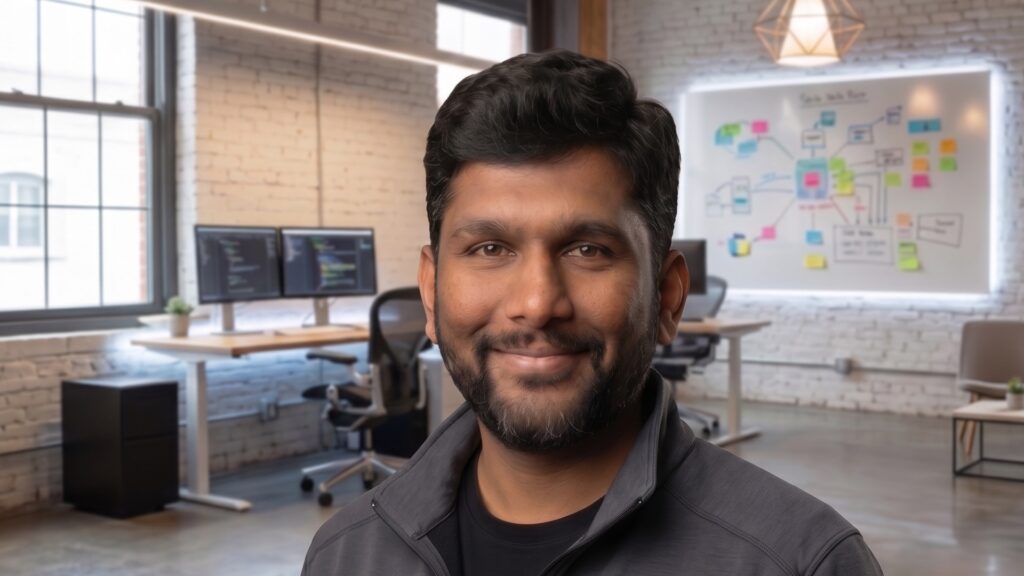
Chandrasekaran Rajendran Receives 2026 Global Recognition Award™
Chandrasekaran Rajendran has been recognized with a 2026 Global Recognition Award for developing agentic AI applications that changed enterprise data engineering practices at a leading financial technology company, placing him among the top ranks of technology leaders honored this year, as his work reshaped how the company approaches data unification and operational efficiency.
Rajendran’s nomination reflects the criteria of innovation and leadership, the two categories he identified as most representative of his contributions, and his self-assessment across the innovation rubric reached the maximum score of five in every dimension, including novelty, market impact, technological advancement, adoption, and disruption of existing paradigms. Global Recognition Awards evaluates shortlisted applicants using the Rasch model, a statistical framework that produces a linear measurement scale, allowing achievements across different fields to be compared fairly and precisely. This method places Rajendran’s contributions alongside peers who operate in entirely different technical domains. His work, therefore, functions not merely as a departmental improvement but as a reference point against which similar efforts can be measured.
Innovation In Practice
Rajendran engineered a generalized, metadata-driven Apache Spark framework that algorithmicized watermark state management, dynamic partition pruning, and optimal schema design—operational vector decisions that have historically relied on manual heuristic intervention. This architecture decouples compute from storage, enabling the seamless elasticity of transient Amazon EMR clusters while internalizing deterministic code validation directly within the ingestion pipeline. Furthermore, they pioneered an AI-augmented migration topology that transitioned legacy Enterprise Care data marts into a high-throughput Segment-driven clickstream ecosystem. This synthesis enabled automated, high-fidelity predictive modeling and operational efficiency forecasting, effectively mitigating the latency inherent in traditional batch-reporting paradigms. By transitioning the enterprise from discrete, schedule-driven processing to a continuous, event-driven streaming modality, this framework established a real-time data-actuation loop previously unattainable under manual workflows.
The empirical outcomes of this architectural intervention yielded substantial, quantifiable systemic advancements. Following the deployment of agentic AI workflows, data worker velocity increased by 25%, while concurrently driving a 30-fold reduction in operational expenditure by automating workflows that had historically required significant engineering overhead. Data dissemination latency was radically compressed, transitioning from a four-day batch-processing lag to a continuous, sub-second near-real-time streaming paradigm. Furthermore, the integration of fault-tolerant monitoring and deterministic alerting topologies guaranteed invariant data delivery to enterprise stakeholders, maintaining systemic integrity irrespective of underlying schema complexity. These metrics rigorously validate the operational milestones delineated in Rajendran’s empirical assessment, exhibiting robust reproducibility when evaluated against the macroeconomic scale of the host enterprise.
Leadership And Organizational Change
Technical improvements rarely succeed without someone willing to manage the friction they create, and Rajendran took on that role directly, balancing the short-term stabilization of legacy pipelines against the longer strategic goal of reducing technology debt across the organization. That balancing act required navigating competing priorities from business stakeholders while still pushing the engineering team toward modernization, and it demanded a leader who could communicate technical tradeoffs in terms that non-technical executives could understand. Few engineers manage dimensions successfully, yet Rajendran sustained this dual focus across multiple product lines simultaneously.
His leadership extended beyond his immediate team’s output, since Rajendran integrated AI-driven auditing to identify infrastructure gaps across business units, ensuring compliance, scalability, and security stayed aligned even as systems grew more complex. Colleagues at the company have repeatedly endorsed his software development and agile methodology skills over more than a decade, a pattern consistent with someone who builds trust through consistent delivery rather than short-term wins. This sustained recognition from peers, combined with measurable business results, sets his leadership apart from that of engineers who deliver isolated technical wins without lasting organizational influence.
Final Words
Rajendran’s career path, from big data and ETL consultant to senior staff software engineer, reflects a steady progression built on technical depth and an increasing willingness to lead through change rather than resist it. This progression demonstrates how sustained expertise can drive organizational change when paired with clear strategic planning. His volunteer work as a judge for the Business Intelligence Group’s Artificial Intelligence Excellence Awards and the Globee Awards for Technology further reflects an individual who is trusted to evaluate the same qualities he has spent his career building, since award organizations rarely select judges who lack demonstrated mastery of the fields they assess.
“Chandrasekaran Rajendran represents exactly the kind of technical leadership Global Recognition Awards was created to celebrate, since he doesn’t just adopt new technology, but changes how an entire organization thinks about data and decision-making,” said Alex Sterling, spokesperson for Global Recognition Awards. His statement explains why the panel viewed Rajendran’s application as exceptional rather than merely competent. His combination of measurable business impact and sustained organizational leadership makes him a clear recipient of a 2026 Global Recognition Award in innovation and leadership.
ADDITIONAL INFORMATION
| Table Header | Table Header |
|---|---|
|
Industry |
Software and Technology |
|
Location |
Dallas, TX, USA |
|
What They Do |
Chandrasekaran Rajendran is a Senior Staff Software Engineer at a leading financial technology company, where he leads data engineering initiatives for the Customer Success organization. He builds and maintains large-scale data pipelines on AWS, using tools like Spark, EMR, and Iceberg to process and organize business data. His work includes designing automated ETL systems, consolidating fragmented metrics into unified definitions, and migrating legacy data systems to modern architectures. He also focuses on infrastructure compliance, covering standards such as GDPR, SOX, and ISO 27001. Beyond his technical work, he manages engineering teams and mentors staff. He applies artificial intelligence tools to streamline workflows and reduce operational costs across data systems supporting tax, sales, and customer service functions. |
|
Website |
Take your business to the next level
Apply today and be a winner