Clearpath Robotics Wins a Global Recognition Award 2026
A forklift accident in a manufacturing facility is not a freak event. It is the statistical certainty that emerges from putting human operators in heavy vehicles, in tight aisles, under productivity pressure, on 12-hour shifts. Approximately 85 workers die in forklift accidents in the US every year. Nearly 35,000 are injured. In 2009, four University of Waterloo mechatronics engineers looked at that number and decided that a robot could do the same job, with the same payload, in the same aisle, without risking a human. They called the company Clearpath Robotics, built both the world’s most widely deployed research robotics platform and the industrial AMR market’s heavy-payload category leader, and sold the company to Rockwell Automation for $550–$600 million in 2023. For 14 years of that mission, 4+ million hours of OTTO operational runtime, 500+ organizations in 40 countries running Clearpath research platforms, a co-created open-source operating system adopted as the global robotics standard, and the world’s first anti-autonomous weapons pledge by a robotics company, Clearpath Robotics has earned a 2026 Global Recognition Award.
Technical Innovation and Architecture
The OTTO 1500 defines industrial AMR engineering: 1,900 kg maximum payload, 2.0 m/s at full capacity, military-spec solid-state computer with dedicated GPU, ISO 13849-1 and ISO 3691-1 safety certification, 360-degree LiDAR and Intel RealSense perception, and 4+ million hours of validated operational runtime since 2015. No competitor carries as much, as fast, with equivalent safety certification. The OTTO Lifter — launched 2022 — became the world’s first truly autonomous forklift, eliminating the single most dangerous routine task in manufacturing. The OTTO 600 completed the portfolio with IP54-rated mid-range capability. Together, the OTTO fleet covers 100 kg to 1,900 kg — the most complete autonomous material handling range of any AMR company globally.
The OTTO software platform delivers continuous value: annual updates improve navigation, fleet coordination, and safety behavior across all deployed units without hardware replacement. On the research side, every Clearpath platform ships ROS 2-ready — allowing MIT, Carnegie Mellon, Stanford, Oxford, NASA, and DARPA to begin experiments within days of delivery. Co-founder Ryan Gariepy co-architected ROS 2 itself — the open-source robot operating system now adopted as the global standard across the entire industry — making Clearpath not just a platform provider but the infrastructure architect of the field.
Market Strategy and Leadership
Matt Rendall, Ryan Gariepy, Pat Martinson, and Bryan Webb founded Clearpath with a founding principle most venture-backed startups now treat as an anomaly: profitability before institutional scale capital. Small angel investment, early revenue, and deliberate growth gave Clearpath the discipline to build two genuinely differentiated product lines before raising the capital that most competitors burned through before proving one. The research division’s credibility — 500 of the world’s most rigorous engineering organizations choosing Clearpath as their platform — gave OTTO Motors its commercial credibility: the same engineering quality and software integration that made Clearpath the research standard made OTTO the trusted AMR for GE Aviation, John Deere, Toyota, and Danfoss.
The Rockwell acquisition — $550–$600 million, with Rockwell outbidding multiple strategic buyers — validated both model and position. Rockwell’s CEO framed the deal precisely: Clearpath enables end-to-end production logistics connecting every layer of the intelligent factory. In October 2025, the first OTTO robots built on Rockwell’s own production line rolled off the line — transforming Clearpath’s founding mission from a Canadian startup to a global manufacturing reality. The line — transforming Clearpath’s founding mission from a Canadian startup to a GE Ventures, Caterpillar Ventures, and Mitsubishi Electric had invested as customers before Rockwell acquired as a strategic buyer — an industrial validation chain that stretches from early stage to enterprise exit.
Industry Impact and Future Vision
The AMR market is growing at a 34.4% CAGR toward $19 billion by 2030. Manufacturing labor shortages, aging workforces, and post-pandemic automation acceleration are structural — not cyclical — drivers. Within this market, OTTO holds what its engineering history earned: the highest payload capacity, the longest operational track record, the broadest safety certification, and the deepest integration with Rockwell’s enterprise automation platform. The research division creates a parallel advantage: every generation of robotics engineers graduating from top programs builds on Clearpath platforms and ROS 2 infrastructure, fostering institutional trust that compounds with each academic cohort.
The OTTO software update model turns deployed robots into recurring software revenue streams. The PartnerBot Grant program creates open-source innovation feedback loops between academic research and commercial deployment. The autonomous forklift capability is the beginning of a portfolio that will eventually replace the full spectrum of human-operated industrial vehicles. Clearpath Robotics earns the 2026 Global Recognition Award for building the infrastructure that the robotics industry runs on — research and industrial, open-source and proprietary, Canadian and global — and for doing it the right way from day one.
OTTO 1500: 1,900 kg payload, 2.0 m/s, military-spec solid-state computer with dedicated GPU, ISO 13849-1/3691-1 safety certification, 360° SICK Microscan3 LiDAR + Intel RealSense cameras — 4+ million hours of validated operational runtime since 2015
OTTO Lifter (2022): world’s first truly autonomous forklift — fully autonomous pallet pickup, transport, and placement in live factory environments
OTTO software update model: annual updates improve navigation intelligence, fleet coordination, and safety behavior across all deployed units — every robot more valuable with each budget cycle, no hardware replacement required
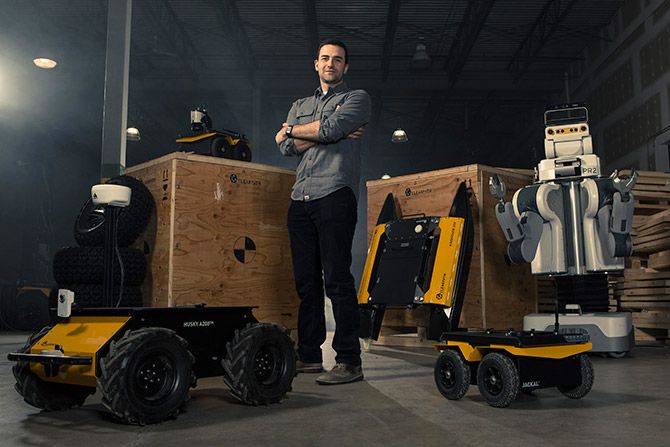
Clearpath research platforms: 12+ distinct robot models (Husky, Jackal, Dingo, Warthog, Ridgeback, TurtleBot) all shipped ROS 2-ready with pre-configured sensors and OutdoorNAV software — days to deployment vs. 12–18 months for custom-built research robots
SLAM + multi-sensor fusion: proprietary simultaneous localization and mapping with LiDAR, RealSense cameras, and 6-axis IMU — infrastructure-free navigation in dynamic factory and outdoor environments
Ryan Gariepy co-architected ROS 2: Clearpath’s CTO co-created the global standard open-source robot operating system adopted across virtually every research and commercial robotics program globally
4+ million hours of OTTO 1500 operational runtime — nearly a decade of continuous validated factory deployment, the deepest proven operational track record of any heavy-payload AMR
500+ organizations in 40+ countries: research division clients span MIT, CMU, Stanford, Oxford, NASA, DARPA, and the US Army Research Laboratory
ICRA 2025 research highlights featured five papers using Clearpath platforms — continued confirmation of research division’s global academic primacy at the world’s premier robotics research conference
$550–$600 million Rockwell Automation acquisition — largest Canadian robotics company acquisition in history, beating multiple strategic buyers in competitive bidding process
First OTTO robots produced on Rockwell’s own manufacturing line: October 2025 — full manufacturing integration milestone
OTTO 600 (600 kg, IP54, all-metal) launched ProMat 2023 — completing the 100 kg to 1,900 kg AMR portfolio range, the most complete autonomous material handling product range of any single AMR manufacturer
AMR market projected at 34.4% CAGR to $19 billion by 2030 — Clearpath/OTTO positioned as the heavy-payload category leader within the fastest-growing segment of industrial automation
Rockwell Connected Enterprise integration: OTTO AMRs embedded within FactoryTalk, Allen-Bradley, and Plex systems create end-to-end production logistics capabilities no standalone AMR competitor can replicate
GE Ventures, Caterpillar Ventures, Mitsubishi Electric as strategic investors: two of the world’s largest industrial companies and one of the world’s largest electrical equipment manufacturers validated OTTO commercially before Rockwell’s acquisition
Dual-division strategy: research division generates academic credibility, open-source community leadership, and a generation of engineers trained on Clearpath platforms; OTTO division generates industrial revenue — each reinforcing the other
Founded on profitability-before-scale model: raised only small angel investment before achieving commercial sustainability — the discipline that produced two differentiated product lines while most competitors burned institutional capital on a single product
Rockwell distribution advantage: access to the world’s largest industrial automation company’s global enterprise sales force — OTTO AMRs embedded in the same purchase conversations as Allen-Bradley controllers, FactoryTalk software, and Plex ERP
OutdoorNAV software stack: outdoor autonomous navigation for Clearpath research platforms with remote navigation and real-time command capability out of the box
ROS 2-ready out of the box: all Clearpath research platforms pre-configured with integrated sensors and working autonomy stack — researchers begin experiments within days of delivery
OTTO fleet management software: centralized control for multi-robot deployments, task scheduling, traffic management, and performance analytics — scalable from pilot deployment to full factory fleet
Modular OTTO design: top panel quick-access for vital components, designed for rapid field servicing by facility maintenance teams without specialized robotics technicians
Autonomous opportunity charging: OTTO 1500 charges autonomously during operational pauses, maintaining continuous availability without human battery management
Pendant-based manual control + guided autonomous control available via OTTO software interface — hybrid operation modes for commissioning, maintenance, and edge-case situations
World’s first anti-autonomous weapons pledge (2014): first robotics company globally to publicly commit to never manufacturing killer robots — a moral leadership position predating every government and industry standard
Workplace safety mission: OTTO AMRs replace human-operated forklifts in the most dangerous material handling workflows — directly addressing the 85 annual US forklift fatalities and 35,000 injuries by removing human operators from vehicle paths
PartnerBot Grant program: donates robots to academic research partners on condition that code and results are contributed to the ROS open-source community — reciprocal open-source model treating knowledge as a public good
ROS 2 co-creation: giving the global robotics community free access to production-grade robot software infrastructure — eliminating the financial barrier that would otherwise require millions per organization to replicate
“Dullest, dirtiest, and deadliest” founding mission: explicitly positions automation as a human protection and dignity tool — protecting workers from hazardous tasks rather than competing with workers for safe employment
Export Development Canada and Canadian government institutional backing: aligned with Canadian industrial policy goals around advanced manufacturing competitiveness, workforce safety, and technology sovereignty