Kinova Wins a Global Recognition Award 2026
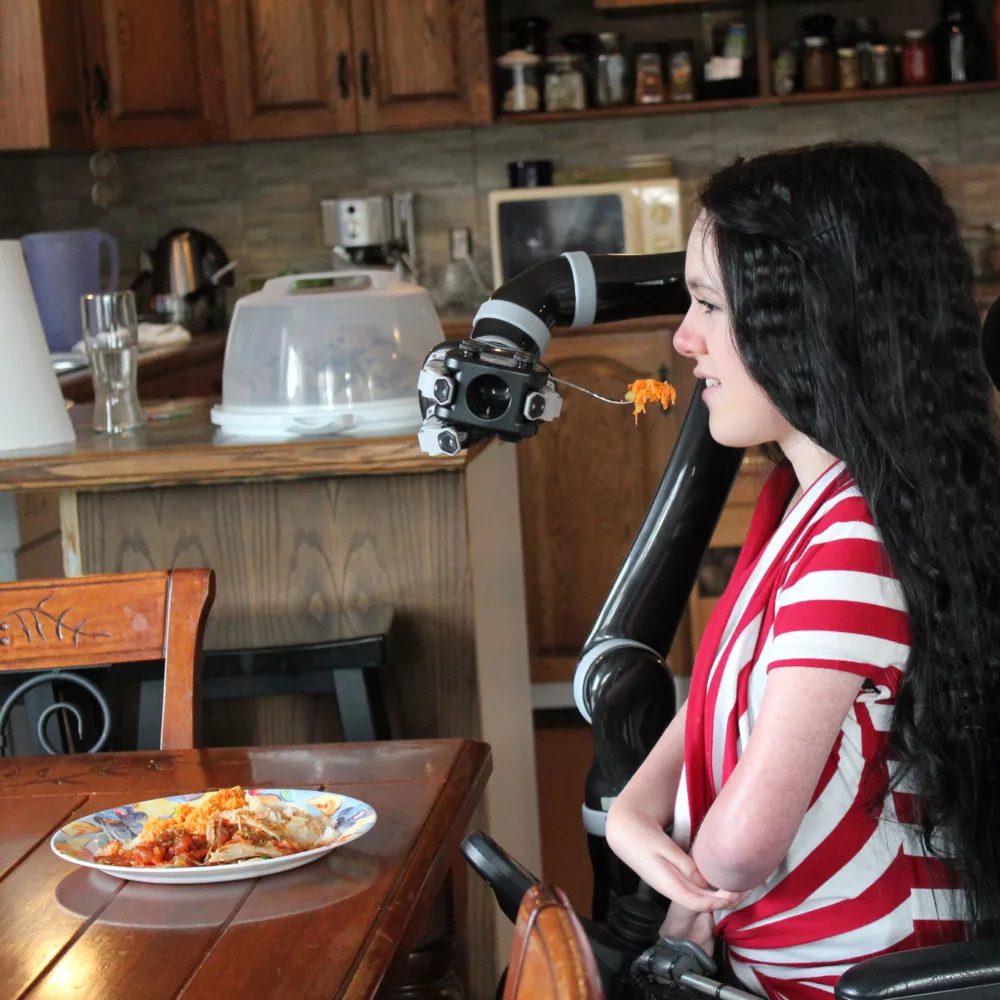
Charles Deguire was an engineering student in Montréal when he recognized a problem no company had solved. Three of his uncles lived with muscular dystrophy. They needed tools to eat, open doors, and scratch an itch — independently. Furthermore, the robots that existed were industrial machines: heavy, dangerous, entirely unsuited for personal use. So Deguire built his own. He co-founded Kinova in 2006, designed the JACO arm, and transformed daily life for people with upper-body mobility limitations. Twenty years later, Kinova arms are mounted on wheelchairs, embedded in Johnson & Johnson surgical robots, deployed in Turkish military EOD teams, and selected as the lead arm technology in a $41.5 million ARPA-H federal initiative. For that journey, Kinova Robotics has earned a 2026 Global Recognition Award.
Technical Innovation and Architecture
Kinova designed its robotic arms to be safe around people, not to be kept in cages away from them. The Gen3, at 8.2 kg with 7 degrees of freedom, integrates depth sensors, a vision module, and a 20-pin expansion connector for custom end-effectors. Furthermore, KORTEX™ — the open API software platform — supports C++, Python, MATLAB, and ROS across Windows and Linux. Consequently, the same architecture powers a surgical OEM integration and a wheelchair-mounted arm for a user with ALS. Additionally, the Gen3 Lite provides an affordable entry point for education, feeding the developer ecosystem that compounds Kinova’s commercial flywheel.
Five Markets, One Architecture
Most robotic arm companies pick one market. Kinova serves five simultaneously — assistive technology, medical OEM, research and academic, defense and security, and industrial automation. Furthermore, the OEM model multiplies commercial reach: the Kinova arm embedded in the Auris Health Monarch Platform ships with every J&J unit sold globally. As a result, Kinova’s installed base grows through its partners’ commercial networks without a proportional investment in direct sales.
ARPA-H, EOD Turkey, and Medical Teleoperation
Three 2025 milestones define Kinova’s trajectory. First, in November 2025, Kinova was selected as the lead robotic arm partner in the $41.5 million ARPA-H RAMMP program — alongside Carnegie Mellon, Cornell, Northeastern, Purdue, AWS, and NVIDIA — the most significant US federal commitment to assistive robotics in history. Second, Gen3 arms deployed in DPM Tech quadruped robot dogs for Turkey’s Gendarmerie EOD teams entered live operational service. Third, the RTI partnership demonstrated 3,000-mile haptic teleoperation at the Surgical Robotics Society Annual Meeting in July 2025.
Capital Structure and Canadian Leadership
Kinova has raised $60+ million in total financing from Graham Partners, Export Development Canada, and the Government of Canada’s Strategic Innovation Fund. Furthermore, Charles Deguire received the Governor General’s Innovation Award in 2018 — Canada’s highest innovation recognition — specifically for the JACO arm. Additionally, the Boisbriand, Québec manufacturing base provides sovereign supply chain assurance that medical, defense, and government procurement increasingly require. Consequently, Kinova holds the rare combination of private equity backing and national industrial policy investment.
Industry Impact and Future Vision
A 2025 PMC/NIH study of JACO arm owners documented specific improvements in autonomy and daily independence — from eating to medication to adjusting glasses. Furthermore, the study’s user experience findings directly inform the ARPA-H RAMMP development roadmap. Consequently, the loop between published clinical evidence and next-generation product development is closed — a feedback cycle that purely commercial robotics companies cannot replicate.
The KORTEX open API means that every algorithm developed in a university lab and every protocol developed in a medical research center contributes to the platform’s total value. Furthermore, 1.3 billion people worldwide live with disabilities — a structural demand that no market forecast can overstate. Kinova Robotics earns the 2026 Global Recognition Award for building the robotic arm that started with a personal mission — three uncles who needed a robot — and grew into the platform that the world’s most demanding applications now depend on.
Gen3 robotic arm: 7-DoF, 8.2 kg, 4 kg payload, integrated depth sensors and vision module, 20-pin expansion connector — configurable for research, medical OEM, defense, and assistive deployments
KORTEX™ open API: C++, Python, MATLAB, ROS-compatible — multi-language, multi-platform software ecosystem supporting a global developer community that compounds value with each new deployment
Gen3 Ultra Lightweight: weight-optimized configuration for wheelchair mounting, UAV integration, and mobile manipulation — extending the platform into weight-sensitive applications no industrial cobot reaches
Gen3 Lite: affordable, compact entry-level arm for education and research — feeding the developer pipeline that has made Kinova the most widely deployed research arm globally
Integrated vision and depth sensing: RGB camera, depth sensors, and accelerometer/gyroscope built into the arm — enabling autonomous grasping and manipulation without external sensor rigs
JACO assistive arm: wheelchair-mountable, lightweight, quiet, weatherproof — designed from day one for safe daily use by individuals with ALS, muscular dystrophy, and spinal cord injury
ARPA-H RAMMP lead partner (November 2025): $41.5 million, 5-year US federal program — largest national commitment to robotic assistive mobility in US history; co-partners include CMU, Cornell, Northeastern, Purdue, AWS, and NVIDIA
Auris Health / J&J Monarch Platform: Kinova arm embedded in FDA-cleared robotic bronchoscopy system — 5-year partnership extension signed 2022; OEM deployment multiplying through J&J’s global installed base
DPM Tech / Turkish Gendarmerie EOD deployment (2026): Gen3 arm live in operational quadruped robot dogs for PAMIT explosive ordnance disposal teams — active defense deployment in highest-risk environment
RTI 3,000-mile haptic teleoperation demo (July 2025): transatlantic remote surgical arm control demonstrated at Surgical Robotics Society Annual Meeting in Strasbourg — most advanced Kinova medical teleoperation proof point
$60M+ total financing: $32M Graham Partners + $16M Strategic Innovation Fund (2022) + $20M federal expansion financing — private equity and sovereign industrial policy combined
Governor General’s Innovation Award (2018): Canada’s highest recognition for innovation, awarded to Charles Deguire specifically for the JACO arm’s impact on quality of life
Five simultaneous end markets: assistive, medical OEM, research/academic, defense/EOD, industrial automation — one Gen3 architecture serving all five without platform fragmentation
Most widely deployed research robotic arm globally: JACO and Gen3 in university robotics labs across North America, Europe, and Asia — the reference platform for academic manipulation research
OEM multiplier model: Kinova arms embedded in partner medical devices ship with partner’s global sales volume — commercial reach growing through J&J, RTI, and future medical robotics OEM partners
Canadian sovereign manufacturing: designed and manufactured in Boisbriand, Québec — domestic supply chain provenance increasingly critical for defense, medical, and government procurement
NVIDIA and AWS affiliated in RAMMP: federal program partnership positions Kinova’s next-gen assistive arm in the same infrastructure ecosystem as the world’s two dominant AI and cloud computing companies
Graham Partners endorsement: “Kinova’s cobot technology and expertise in both medical and industrial applications is unique in the robotics industry” — private equity conviction that validates the multi-sector architecture thesis
ROS compatibility: full ROS integration in KORTEX — the standard research robotics middleware — making Gen3 the lowest-friction arm for any university or corporate research team
Open API ecosystem: C++, Python, MATLAB — three of the four most common languages in robotics, data science, and engineering; developer accessibility that no closed-platform competitor provides
Wheelchair integration: JACO mounts directly to wheelchair power systems — no external power source or modification required; 15+ years of real-world wheelchair deployment reliability
Peer-reviewed user evidence: 2025 PMC/NIH study documents specific JACO arm outcomes — autonomy gains, mental well-being improvement, daily independence — from owners with ALS, SMA, and spinal cord injury
Modular end-effector compatibility: 20-pin expansion connector enables custom gripper and sensor integration — any research team or OEM partner can design purpose-specific tooling without arm replacement
Intuitive control interfaces: USB and gamepad support alongside full API access — enabling both expert programming and accessible operator-level use in assistive and educational deployments
Personal founding mission: Charles Deguire built Kinova to help his three uncles with muscular dystrophy — 20 years of authentic alignment between the CEO’s personal history and the company’s core product
EOD human protection: Gen3 arm replaces human entry into explosive, CBRN, and disaster zones — every operational deployment directly reduces risk of human death or injury
1.3 billion people with disabilities: JACO and RAMMP address the structural independence needs of the world’s largest underserved population — a social mission that scales with every new assistive deployment
Canadian manufacturing sovereignty: Boisbriand production base supports Canadian employment, supply chain independence, and national technology capability in critical robotics infrastructure
Democratizing robotics access: Gen3 Lite pricing and open API lower barriers for smaller research institutions, emerging market universities, and early-stage medical robotics startups
Clinical feedback loop: 2025 PMC/NIH study findings directly informing ARPA-H RAMMP design — evidence-based product development cycle that continuously improves outcomes for people with disabilities