
BenchSci Wins a Global Recognition Award 2026
A drug discovery scientist sits down to begin a new target identification project. The biological literature relevant to her therapeutic area spans hundreds of thousands of papers, preprints, and proprietary datasets — far more than any team could read, let alone synthesize. The specific experimental data she needs may exist somewhere in that volume, but the tools available to her were built for search, not for understanding. Hours turn into days. Weeks turn into months. And somewhere in that delay, a promising target may be abandoned — or an unpromising one pursued — based on an incomplete picture of what the biology actually says. BenchSci, the Toronto-based AI company founded in 2015, has earned a 2026 Global Recognition Award for solving this problem at the scale the pharmaceutical industry actually requires. With 16 of the world’s top 20 pharmaceutical companies deploying its ASCEND™ platform, $218 million in funding, and a knowledge graph mapping over 400 million biological entities, BenchSci has built the most widely adopted AI co-pilot for preclinical drug discovery.
Technical Innovation and Architecture
ASCEND™ is built on a specific architectural decision: neurosymbolic AI. This means the platform combines neural network capabilities — natural language processing, pattern recognition across vast datasets, generative hypothesis formation — with a structured symbolic knowledge graph that grounds every output in traceable experimental evidence. The foundation of this system is the Biological Evidence Knowledge Graph (BEKG), a proprietary map encoding over 400 million biological entities and more than one billion relationships, drawn from scientific publications, preprints, patents, reagent catalogs, and curated databases including UniProt, KEGG, the Human Protein Atlas, and the FDA. Every query, every hypothesis, and every target suggestion the platform generates is linked back to the specific experiments and data sources from which it was derived. This is not a design choice made for marketing purposes — it is the technical requirement that makes the platform usable in pharmaceutical environments where regulatory scrutiny demands that every scientific decision be traceable and defensible.
ASCEND prioritizes biological targets based on the quality of underlying evidence, not on publication frequency — filtering out noise, flagging preclinical risk factors, and surfacing the experimental relationships that matter. In November 2025, BenchSci launched LEAP (Learning and Evidence-based AI for Predicting novel biology), an inference engine capable of generating novel biological hypotheses and predicting experimental assay outcomes. That same month, BenchSci announced a partnership with Mila — the Quebec AI Institute and one of the world’s leading academic deep learning research centers — to develop next-generation biological inference models and advance the platform toward autonomous drug discovery. Together, ASCEND and LEAP form a platform that is moving from AI-assisted decision support toward AI-generated scientific insight — a transition with significant implications for how pharmaceutical R&D will operate over the next decade.
Market Strategy and Leadership
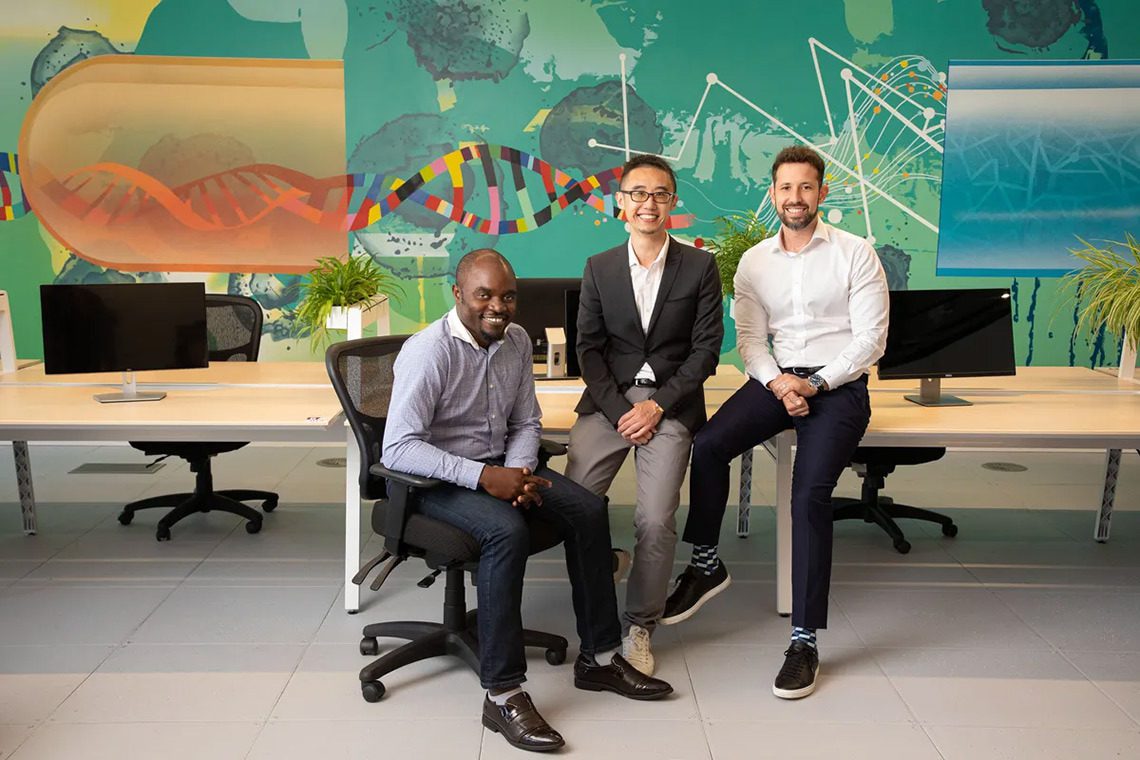
CEO and co-founder Liran Belenzon joined BenchSci through the University of Toronto’s Creative Destruction Lab after Chief Scientist and founder Tom Leung — who first conceived the idea while conducting cancer research — recruited AI engineers David Q. Chen and Elvis Wianda to build the technical foundation. That four-person founding team, assembled in 2015, represents the company’s core strategic balance: scientific domain expertise, machine learning engineering, and commercial execution working from a shared problem rather than a funding thesis. Between the Series C (2021) and Series D (2023), Belenzon tripled revenue, doubled headcount from 200 to 400, and expanded the top-20 pharma client count by three — an operational execution record that justified Generation Investment Management, Google’s Gradient Ventures, Inovia Capital, TCV, and F-Prime co-leading a $95 million Series D. The total funding base now stands at $218 million.
BenchSci’s commercial momentum in 2025 reads as a sequence of compounding commitments. In September, Thermo Fisher Scientific — a $43 billion revenue global laboratory company — announced a strategic partnership to embed ASCEND AI capabilities into enterprise software for scientific instruments, literature search, and reagent selection. In October, Sanofi signed a three-year global license agreement to deploy ASCEND across its entire preclinical research organization worldwide. In December, Merck renewed its global ASCEND agreement after a successful two-year deployment. These are not letters of intent or pilot programs — they are multi-year enterprise commitments from three of the world’s largest pharmaceutical companies, signed within a single calendar quarter.
Industry Impact and Future Vision
Drug discovery’s failure rate is structural. Roughly 90% of drug candidates that enter clinical trials do not receive approval. The leading cause is not poor chemistry or flawed manufacturing — it is flawed biology: the wrong target, the wrong disease mechanism, the wrong hypothesis pursued too far down a costly pipeline. BenchSci’s platform intervenes at the point where that failure originates: before the first experiment is designed, when scientists are deciding which biological targets to pursue. By giving scientists access to a knowledge graph that synthesizes 10 years of accumulated biological evidence across 400 million entities, ASCEND changes the quality of the questions scientists ask — and the probability that the answers they pursue are worth the resources they require. Over 4,500 research centers globally now use the platform, alongside 16 of the world’s top 20 pharmaceutical companies, making BenchSci’s biological evidence layer one of the most widely embedded AI systems in pharmaceutical R&D.
The trajectory beyond 2025 is clearly defined. LEAP’s inference capabilities will advance with each iteration of the Mila collaboration. These systems can generate, test, and rank novel scientific hypotheses without requiring the same volume of human-directed querying as current workflows demand. Thermo Fisher’s global footprint will extend ASCEND’s reach into research environments that BenchSci’s direct enterprise sales team would take years to access independently. The BEKG will continue to grow in density and accuracy as new experimental data from pharmaceutical partners and the public literature flows in — each addition strengthening the platform’s predictive foundation. BenchSci earns the 2026 Global Recognition Award because it has already changed how the world’s most important pharmaceutical companies conduct preclinical research — and because the platform it has built is designed, by architecture, to become more valuable with every drug discovery decision made on top of it.
400+ million entities and 1+ billion relationships in proprietary knowledge graph extracted from scientific publications, patents, and reagent catalogs, representing years of curation creating competitive moat
Over 100 proprietary machine learning models specialized for biomedical literature that decode unstructured scientific documents extracting insights from both text and images (Western blots, immunofluorescence, flow cytometry)
Deep learning architecture processes millions of scientific papers using computer vision and NLP to capture experimental context—what was tested, how experiments were conducted, what results were observed
Traceability infrastructure ensuring every AI-generated recommendation links back to original source publications, distinguishing platform from pure LLM approaches prone to hallucination
Multi-source data integration combining closed-access publications (through publisher partnerships), open-access journals, reagent vendor catalogs, and customer proprietary data in unified search architecture
Continuous learning system where every compound tested feeds back into AI models improving prediction accuracy in virtuous cycles, with platform ingesting latest scientific data globally
22% novel target/indication discovery rate in key projects from top 10 pharmaceutical customers through knowledge graph analysis identifying connections human researchers miss
40% reduction in unnecessary experimentation achieved through AI-guided experimental design and evidence-based protocol selection avoiding low-reproducibility approaches
Millions of dollars in annual savings for large pharmaceutical customers through avoided failed experiments and accelerated project timelines
Weeks to months saved per project in literature review and experimental design phases, reducing drug candidate identification from hundreds of hours to minutes
50,000+ scientists using platform daily at 4,500+ leading research centers worldwide, demonstrating massive user adoption and network effects
Deloitte Technology Fast 50 and Fast 500 recognition in both 2024 and 2025, indicating revenue growth exceeding 50% CAGR qualifying for prestigious fastest-growing technology company awards
16 of top 20 pharmaceutical companies as customers including publicly confirmed Sanofi three-year partnership plus likely Pfizer, Roche, Novartis, AstraZeneca, GSK based on industry penetration
$218 million CAD total funding ($170M USD) including $95M Series D led by Generation Investment Management (Al Gore’s sustainability-focused firm) validating healthcare system efficiency mission
Sanofi three-year strategic partnership (October 2025) deploying ASCEND platform across global preclinical research organization representing major pharma endorsement
Thermo Fisher Scientific collaboration (September 2025) with leading life sciences tools provider developing integrated software solutions expanding ecosystem reach
Mila multi-year partnership (December 2025) collaborating with Yoshua Bengio’s prestigious Montreal AI institute (Turing Award winner) advancing cutting-edge AI capabilities
Creative Destruction Lab origins connecting founders with mentors Geoffrey Hinton and Yoshua Bengio (both Turing Award winners) plus Toronto AI ecosystem providing world-class talent pipeline
Evidence-based reagent selection enabling researchers to find validated antibodies, recombinant proteins, RNAi, cell lines, CRISPR reagents, and animal models in minutes versus weeks of manual searching
Experimental reproducibility focus, highlighting which protocols yield consistent results versus those introducing variability, addressing the pharmaceutical industry’s crisis, where 50% of published experiments cannot be reproduced
User-friendly interface designed by Chief Design Officer Elvis Wianda, enabling searches by target and reagent type, and experiment-specific recommendations comparing ,specifications without extensive training
Proprietary ontology organizing biomedical information helping researchers understand significance and establish relationships between genes, proteins, diseases, and drugs in an intuitive visual format
Customer proprietary data integration allowing pharmaceutical companies to unify searches across public scientific literature and private internal experiments in a single platform
Publisher partnership network providing access to closed-access scientific publications, creating comprehensive data coverage beyond competitors, relying only on open-access sources
Healthcare system sustainability mission, reducing wasteful preclinical experimentation where 80% of experiments are unnecessary, translating to billions in wasted R&D spending, ultimately passed to patients through drug pricing
Generation Investment Management backing (Al Gore’s ESG-focused firm), validating platform’s contribution to sustainable healthcare through more efficient drug development, reducing time, cost, and resource consumption
Scientific integrity advancement addressing the reproducibility crisis by curating evidence highlighting reliable experimental protocols versus unreliable methods, improving scientific rigor, and benefiting the entire research community
Accelerated drug discovery timelines enabling faster development of life-saving medicines, particularly for rare diseases and underserved patient populations lacking therapeutic options
Academic institution access serving over 4,500 research centers, including universities and teaching hospitals, democratizing AI-powered literature analysis beyond only well-funded pharmaceutical companies
Reduced animal experimentation through evidence-based experimental design, helping researchers avoid failed approaches upfront, potentially decreasing unnecessary animal model usage in preclinical research