Oxford Ionics Wins a Global Recognition Award 2026
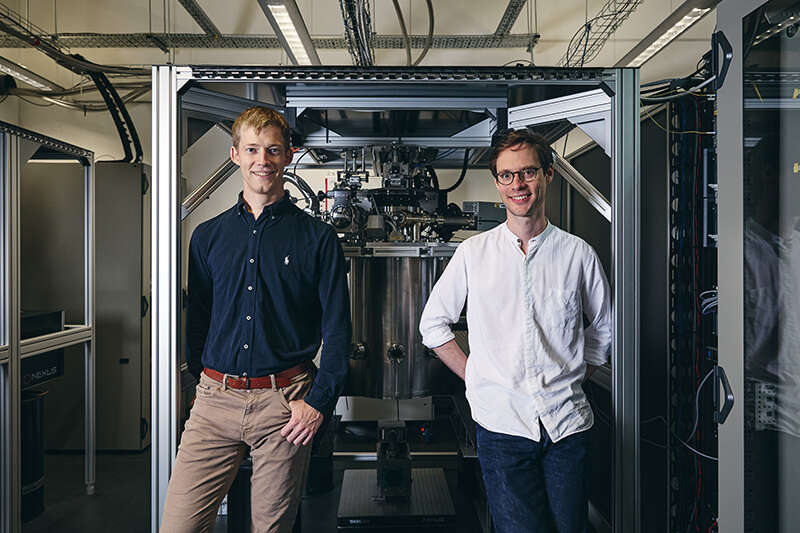
Two physicists sit in a small, windowless room in an Oxford basement in 2019. On the whiteboard between them is a clear statement of what the quantum computing field has gotten wrong: trapped-ion qubits are the highest-fidelity quantum system in existence, but every attempt to scale them requires lasers. Lasers cannot be manufactured on an industrial scale. The solution they sketch that day, replacing every laser with on-chip electronics fabricated in standard semiconductor foundries, becomes Electronic Qubit Control. This invention earned Oxford Ionics a 2026 Global Recognition Award and a $1.075 billion acquisition by IonQ in September 2025, the largest quantum computing acquisition in history.
Technical Innovation and Architecture
Oxford Ionics‘ Electronic Qubit Control architecture represents the first fundamental breakthrough in trapped-ion quantum computing in three decades. Traditional trapped-ion systems, while producing the highest qubit fidelities of any technology, require precisely aligned optical systems to control individual ions, making the architecture impossible to manufacture at an industrial scale because optical alignment cannot be maintained across chip-scale production runs. EQC eliminates this barrier: a classical silicon chip, fabricated in the same semiconductor foundries that produce laptop and data center processors, uses precisely engineered electrodes to trap barium ions tens of micrometers above the chip surface and transport them across a two-dimensional grid using electronics alone. The QPU is a multi-layer chip integrating control electronics and photonic technology on a single manufacturable substrate, with a copy-paste unit-cell architecture enabling scaling to millions of qubits through straightforward geometric replication rather than system redesign.
Oxford Ionics has achieved record-setting qubit control fidelities for any semiconductor-manufacturable trapped-ion system, maintaining the accuracy advantage of the trapped-ion modality while simultaneously achieving the manufacturing compatibility of silicon fabrication, a combination that every competing trapped-ion system sacrifices one for the other to achieve. The QUARTET quantum computer, delivered to the UK National Quantum Computing Centre at Harwell in August 2025, demonstrated this architecture at system level in the UK’s national quantum research infrastructure, and was selected for the Quantum Missions Q-Surge project alongside Riverlane and Bay Photonics to upgrade to full 2D qubit connectivity, confirming that Oxford Ionics’ hardware meets the performance standards of the UK’s sovereign quantum program.
Market Strategy and Leadership
Dr. Chris Ballance and Dr. Thomas Harty founded Oxford Ionics in 2019 as a spinout from the University of Oxford, where Ballance’s 2016 paper in Physical Review Letters had established a world record for two-qubit gate fidelity at 99.9%, the most cited experimental result in trapped-ion quantum computing and the direct scientific predecessor to EQC. Investors who understood this immediately included Hermann Hauser, founder of ARM Holdings and Europe’s most credible semiconductor-to-deep-tech investor, and Niels Nielsen, former chairman of Cambridge Quantum, who brought direct institutional knowledge of what a commercial quantum company requires. The Institute of Physics Business Innovation Award in 2024 provided independent technical recognition before the IonQ acquisition resolved the competitive landscape in Oxford Ionics’ favor.
IonQ’s $1.075 billion acquisition, signed in June 2025 and completed in September 2025, was strategically explicit: IonQ identified EQC as the semiconductor manufacturing layer it needed to execute a roadmap that no single organization could build alone. The combined entity’s published targets, 256 physical qubits at 99.99% accuracy by 2026, over 10,000 physical qubits with logical accuracies of 99.99999% by 2027, and 2 million physical qubits by 2030, represent engineering commitments backed by two organizations whose complementary capabilities now constitute the most comprehensive trapped-ion development program in the world. All existing Oxford Ionics government partnerships in the UK, including the NQCC, Innovate UK, and the Quantum Missions program, were maintained through the acquisition, confirming that sovereign quantum capability commitments were preserved.
Industry Impact and Future Vision
Oxford Ionics’ impact on the field of quantum computing is structural and permanent. By demonstrating that laser-free electronic control of trapped ions achieves record-setting fidelity at semiconductor manufacturing scale, the company ended a decade-long debate about whether the trapped-ion modality could ever become commercially manufacturable. The NQCC QUARTET deployment demonstrates that EQC systems can meet the standards of national quantum research infrastructure, creating a reference architecture for government, defense, and pharmaceutical organizations that need quantum computers whose performance is independently verified rather than vendor-asserted.
The combined IonQ-Oxford Ionics roadmap to 2 million physical qubits at logical accuracies exceeding 99.9999999999% by 2030 represents the most ambitious but technically grounded published roadmap in quantum computing, backed by EQC’s semiconductor manufacturing compatibility, IonQ’s enterprise deployment infrastructure, and the combined organization’s government contract base across the US and UK. The 2026 Global Recognition Award captures the full arc of what Oxford Ionics achieved as an independent company: from a precise founding insight about what quantum computing required, to a peer-reviewed world record, to a system deployed in national research infrastructure, to a billion-dollar acquisition that validated every technical claim the founders made in that windowless Oxford basement six years earlier
Electronic Qubit Control replaces lasers entirely with on-chip electronics, eliminating the scaling barrier that prevented trapped-ion quantum computing from becoming manufacturably scalable for three decades
Classical silicon QPU fabricated in standard semiconductor foundries, the same facilities used for laptop and data center processors, enabling industrial-scale quantum chip production
Copy-paste unit cell architecture enables scaling to millions of qubits through geometric replication without system redesign, a structural advantage no laser-based architecture can replicate
Barium ion qubits trapped and transported across a 2D grid via electrode-controlled electric fields, achieving record-setting fidelity for semiconductor-manufacturable trapped-ion hardware
QUARTET system delivered to UK NQCC Harwell (August 2025), confirming system-level performance at national quantum research laboratory standards
Selected for UK Quantum Missions Q-Surge project with Riverlane and Bay Photonics to upgrade QUARTET to full 2D qubit connectivity, validating 2D ion transport in a funded national context
$1.075 billion IonQ acquisition completed September 2025, the largest quantum computing acquisition in history
Combined IonQ-Oxford Ionics roadmap: 256 qubits at 99.99% accuracy (2026), 10,000+ qubits at 99.99999% logical accuracy (2027), 2 million qubits at 99.9999999999% logical accuracy (2030)
Record-setting two-qubit gate fidelity at 99.9% established by Dr. Chris Ballance’s 2016 Physical Review Letters paper, the direct scientific predecessor to EQC
IOP Business Innovation Award 2024 from the Institute of Physics, independent technical recognition preceding acquisition
Six years from founding to $1 billion acquisition, one of the fastest deep-tech value creation trajectories in European quantum history
All existing government partnerships in UK maintained post-acquisition, including NQCC, Innovate UK, and Quantum Missions program
Hermann Hauser (ARM founder) and Niels Nielsen (ex-Cambridge Quantum chairman) as early investors, combining semiconductor scaling expertise with quantum industry domain knowledge
Oxford Science Enterprises has been backed from the founding, providing University of Oxford with institutional support and access to deep physics talent pipelines
IonQ acquisition provides access to existing enterprise customer relationships, US government contracts, and commercial deployment infrastructure that would have taken Oxford Ionics years to build independently
Combined company maintains UK R&D presence post-acquisition, preserving national quantum capability and government partnership continuity
EQC architecture positions the combined IonQ entity as the only quantum hardware company with both record trapped-ion fidelity and semiconductor manufacturing compatibility
Target sectors for combined company: drug discovery, materials science, financial modeling, logistics, chemistry, aerospace, cybersecurity, and defense
Semiconductor foundry manufacturing means Oxford Ionics quantum systems can be produced and delivered through the same supply chain infrastructure that services global data center hardware procurement
NQCC deployment demonstrates end-to-end installation and operation of Oxford Ionics hardware in a shared national research data center environment
Existing IonQ enterprise and government customer relationships provide Oxford Ionics EQC systems with an immediate commercial distribution channel post-acquisition
UK Quantum Missions Q-Surge collaboration provides Oxford Ionics hardware with access to Riverlane’s world-leading quantum error correction software, improving effective logical qubit performance
Government partnership continuity post-acquisition ensures that UK institutional clients face no disruption to existing contracts, timelines, or technical specifications
Combined 2026 roadmap target of 256 qubits at 99.99% accuracy provides enterprise clients with a near-term deployment capability at fidelity levels required for commercially relevant quantum algorithms
Semiconductor foundry compatibility reduces the capital and environmental cost of quantum hardware manufacturing by leveraging existing industrial infrastructure rather than building parallel quantum-specific fabrication facilities
UK national quantum capability preservation through maintained NQCC and Quantum Missions partnerships ensures that quantum computing advances remain accessible to UK researchers and government bodies
Cybersecurity and defense applications of fault-tolerant quantum computing, targeted by the combined IonQ roadmap, contribute to the security of democratic nations’ critical infrastructure against future quantum-enabled threats
University of Oxford spinout model demonstrates that the UK’s academic research investment generates globally consequential deep-tech companies, supporting the case for continued public science funding
Drug discovery and materials science applications of the combined roadmap target diseases and energy materials that affect the global population, with direct humanitarian and sustainability implications
ARM founder Hermann Hauser’s involvement continues a pattern of UK semiconductor expertise being reinvested into the next generation of deep technology, creating continuity in the UK’s hardware innovation ecosystem