
Deep Robotics Wins a Global Recognition Award 2026
In 2006, Zhu Qiuguo competed in RoboCup as a Zhejiang University undergraduate, fine-tuning robot hardware and software for competition and learning the gap between theory and reliable real-world performance. A decade of doctoral research, humanoid robot development, and watching Boston Dynamics later, he co-founded Deep Robotics in Hangzhou in November 2017. Today, the X30 Jueying robot dog inspects Singapore’s 40km underground power cable tunnel, has established Saudi Arabia’s first fully automated outdoor inspection system at NEOM, and operates across nearly 30 substations of China Southern Power Grid, achieving documented 70%+ cost reduction. Furthermore, a $68 million Series C closed in December 2025 — with China Telecom and China Unicom as strategic investors — to fund 5G infrastructure for system-level robot fleet coordination at the national scale. For that platform, Deep Robotics has earned a 2026 Global Recognition Award.
Technical Innovation and Architecture
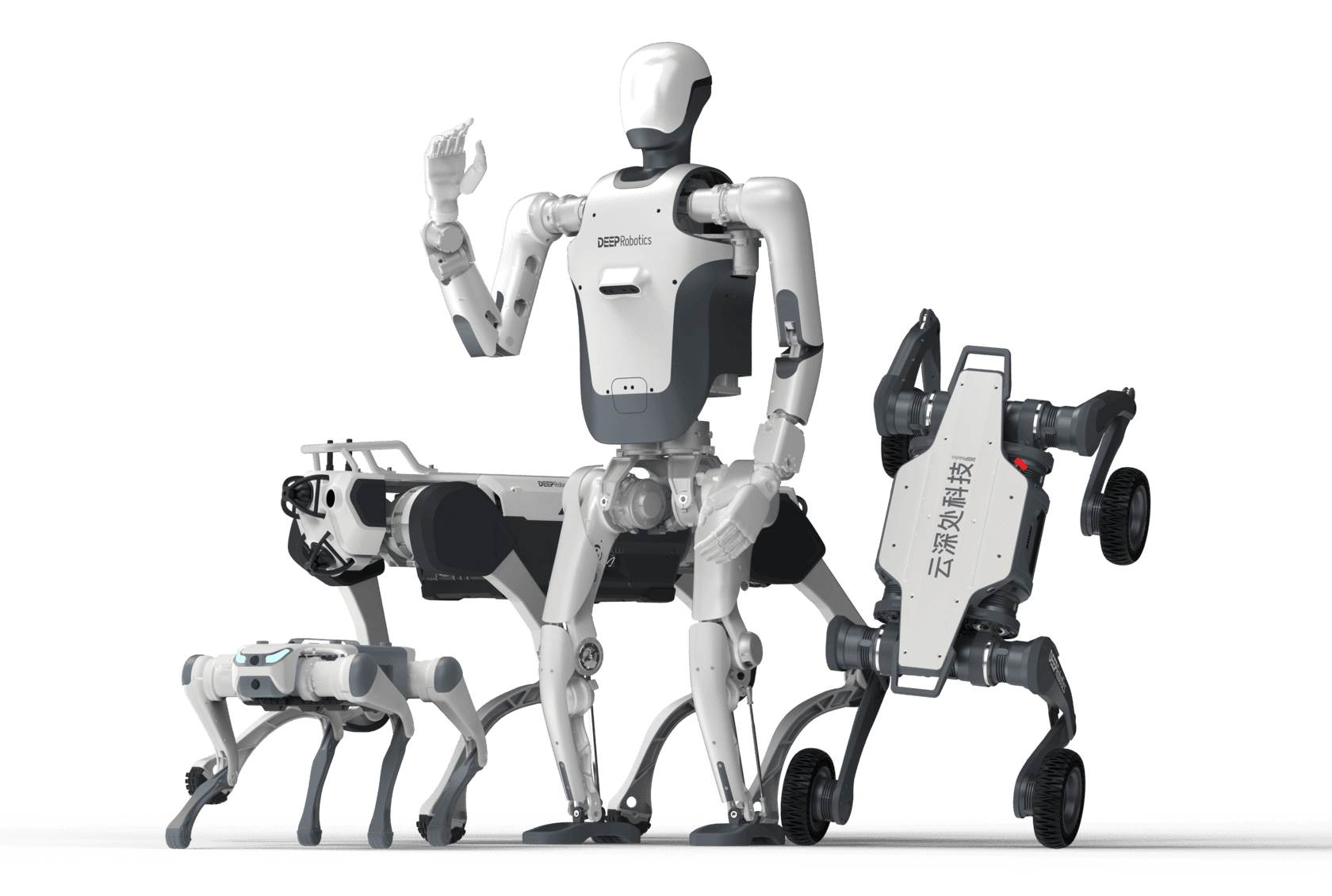
The Jueying X30 operates from -20°C to +55°C, is IP67-rated, climbs 45-degree slopes, and navigates in complete darkness using LiDAR, depth cameras, and thermal imaging. Furthermore, reinforcement learning-based autonomous navigation enables fully independent path planning and obstacle avoidance without pre-programmed routes. The Lynx M20 — launched April 2025 — combines 4 m/s wheel speed with 80cm obstacle leg clearance in a 33 kg, IP66 single-person portable package. Additionally, DeepVLA 1.0 — a Visual-Language-Action embodied AI model — enables natural-language mission commands and multi-floor autonomous navigation, representing the architectural leap from task-specific robots to general-purpose embodied AI.
Singapore, NEOM, and the Power Grid Benchmark
Three international deployments define Deep Robotics‘ global trajectory. First, the X30 “SPock” is commercially deployed in Singapore SP Group’s 40km underground transmission tunnel — the first Chinese quadruped in an overseas power utility, detecting cracks, water seepage, and temperature anomalies in real time. Second, the X30 established NEOM, Saudi Arabia’s first fully automated outdoor inspection system — replacing a four-hour human patrol with continuous uncrewed operation. Third, China Southern Power Grid’s 30 substations complete full inspections in under 35 minutes, achieving 70%+ operational cost reduction. Furthermore, these three deployments span three continents and confirm that Deep Robotics’ platform is globally deployable.
Founding Pedigree and the “Six Little Dragons”
Zhu Qiuguo’s academic identity is inseparable from Zhejiang University — China’s most consequential engineering institution for AI and robotics spin-outs. Specifically, ZJU alums in Zhu’s cohort include DeepSeek founder Liang Wenfeng. Both are members of Hangzhou’s “Six Little Dragons” — recognized by Zhejiang University, The Economist, and Diplomat Magazine. Furthermore, Zhu maintains his active role as an Associate Professor and PhD advisor at ZJU — continuously feeding China’s most rigorous robotics research into Deep Robotics’ product pipeline. Additionally, his World Economic Forum recognition positions Deep Robotics within global responsible AI governance frameworks.
Series C and 5G Infrastructure Backing
The $68 million Series C is structurally unique. China Telecom and China Unicom did not invest as financial VCs. They invested as 5G and edge computing infrastructure owners — committing to the physical connectivity layer that coordinates robot fleets at a national scale. Furthermore, CMB International and ChinaAMC provide the commercial banking and institutional asset management conviction. Caixin estimates Deep Robotics’ valuation at $300–500 million — the highest valuation for a pure-play quadruped company globally, outside Boston Dynamics.
Industry Impact and Future Vision
Critical infrastructure inspection is approaching a structural inflection point. Aging power grids, expanding renewable energy, and increasingly extreme climate events simultaneously increase inspection demand and inspector hazard. Furthermore, emergency response validation — X30 as a core force in national disaster drills and high-rise fire reconnaissance — demonstrates a platform deployable in unstructured, time-critical, life-at-risk scenarios, not just scheduled maintenance. Additionally, the DR02 industrial humanoid extends the addressable market into factory automation — a sector that Goldman Sachs projects will reach $38 billion by 2035.
DeepVLA 1.0 improves with every mission deployed — an AI flywheel that compounds the platform’s value with each new robot in the field. China Telecom and China Unicom provide the infrastructure to coordinate thousands of robot fleets simultaneously. Most importantly, Deep Robotics is no longer a quadruped robot company. It is an embodied AI company — using Jueying as the commercial foundation, Lynx M20 as terrain extension, and DR02 as the industrial humanoid frontier — all powered by Zhejiang University’s most consequential robotics lab. Deep Robotics earns the 2026 Global Recognition Award for building the embodied AI platform that critical infrastructure worldwide now depends on.
Jueying X30: -20°C to +55°C, IP67, 45-degree slope climbing, complete darkness navigation via LiDAR + depth camera + thermal imaging fusion — the broadest certified operating envelope of any deployed quadruped
Reinforcement learning autonomous navigation: independently plans paths, avoids obstacles, and executes inspection missions without pre-programmed routes — adapts continuously to new environments through in-field learning
Lynx M20 wheeled-legged hybrid (April 2025): world’s first — 4 m/s wheel speed, 80cm obstacle clearance, 33 kg portable, IP66 — combining the speed and agility trade-off no single-modality robot resolves
DeepVLA 1.0 Visual-Language-Action model: natural language mission commands + multi-floor autonomous navigation — the embodied AI layer that transforms hardware robots into general-purpose platform intelligence
DR02 industrial humanoid: all-weather operation -20°C to +55°C — Deep Robotics’ formal entry into the industrial humanoid sector for factory and manufacturing automation environments
Multi-sensor fusion perception: LiDAR + depth cameras + thermal imaging + AI algorithms — structural crack detection, insulation degradation analysis, temperature monitoring, gas concentration sensing in one platform
China Southern Power Grid — 30 substations, 70%+ cost reduction: full inspection in under 35 minutes vs. ~2 hours manual — largest documented power infrastructure quadruped deployment globally at production scale
Singapore SP Group “SPock” (February 2025): first Chinese quadruped in overseas power utility; commercial deployment in 40km underground transmission tunnel — real-time defect detection replacing human cable inspection
NEOM Saudi Arabia — first fully automated outdoor inspection: X30 replaced four-hour human patrol with continuous unmanned operation in extreme beach environment; first such system in Saudi Arabian history
$68M Series C (December 2025): led by CMB International and ChinaAMC, with China Telecom and China Unicom as strategic investors — 5G infrastructure backing for system-level robot fleet coordination
$300–500M valuation (Caixin): highest-valued pure-play quadruped robotics company outside Boston Dynamics globally, pre-IPO
National emergency rescue drill deployment: X30 as core rescue force in “2025 Joint Emergency Rescue Drill for Concurrent Multi-Type Accidents” — multi-province, multi-hazard national validation
Six Little Dragons” Zhejiang University cohort: same ZJU alumni network as DeepSeek founder Liang Wenfeng — China’s most internationally credible academic-to-commercial robotics pedigree
World Economic Forum recognition of Zhu Qiuguo: global policy-level acknowledgment positioning Deep Robotics within international responsible AI governance — critical for enterprise procurement in Western and Middle Eastern markets
Five-platform product family: X30, X20, Lynx M20, Lite3, DR02 humanoid — full architecture from industrial inspection to wheeled-legged hybrid to humanoid; no competitor covers this range from one founding team
China Telecom + China Unicom 5G infrastructure investment: not financial VCs — national 5G and edge computing infrastructure owners committed to system-level robot fleet coordination at scale
ETH Zurich + Georgia Tech core team: Deep Robotics founding engineers from ZJU, PKU, SJTU, HUST, UCAS, ETH Zurich, and Georgia Tech — the most globally credible academic engineering consortium of any Chinese robotics startup
CES 2026 + IROS 2025 presenter: demonstrated at world’s largest technology exhibition and world’s premier robotics research conference simultaneously in 2025–2026
Single-person portable (Lynx M20, 33 kg): no crane or specialist deployment equipment — any field team member transports and deploys in any environment
Automatic recharging and task resumption: robots return to charging stations, recharge, and resume scheduled inspection missions without human intervention — 24/7 uninterrupted operation
Natural language mission interface (DeepVLA 1.0): operators issue verbal mission parameters rather than programming routes — reducing deployment customization time from days to hours
Real-time anomaly reporting: detected defects — cracks, water seepage, temperature spikes, gas concentrations — automatically documented and transmitted to command operators without human review of footage
Two-way voice intercom module: robots deployed in security scenarios can autonomously activate voice communication to intervene with detected anomalies — live human-robot-environment interaction
Cross-platform SP Group software customization: Deep Robotics tailored X30 sensors, algorithms, and navigation logic specifically for Singapore’s tunnel layouts — confirming international deployment adaptation capability
Robots face danger so humans don’t: every primary deployment context — active firegrounds, cable tunnels, chemical plants, explosive ordnance zones, extreme desert environments — specifically replaces the highest-risk human occupational exposures
NEOM sustainability context: Deep Robotics robots deployed in a project explicitly designed as a net-zero, AI-powered megacity — electric autonomous inspection replacing fossil-fuel human patrol vehicle rounds
Zhu Qiuguo’s academic dual role: CEO maintaining active ZJU Associate Professor and PhD advisor appointment — continuous ethics and research governance influence from China’s most rigorous engineering institution
70%+ cost reduction at China Southern Power Grid: fewer vehicles, less personnel exposure, reduced physical fatigue — documented operational improvements across environmental, safety, and economic dimensions simultaneously
Open academic founding: built from publicly funded Zhejiang University research, technology transfer from national academic investment to commercial industrial application
Emergency response humanitarian mission: X30 validated in chemical deflagration, typhoon, flood, and high-rise fire scenarios — humanitarian infrastructure protecting civilian populations from natural and industrial disasters