WINNER 2026
Vera Simone Nova Celebrates 2026 Global Recognition Award™

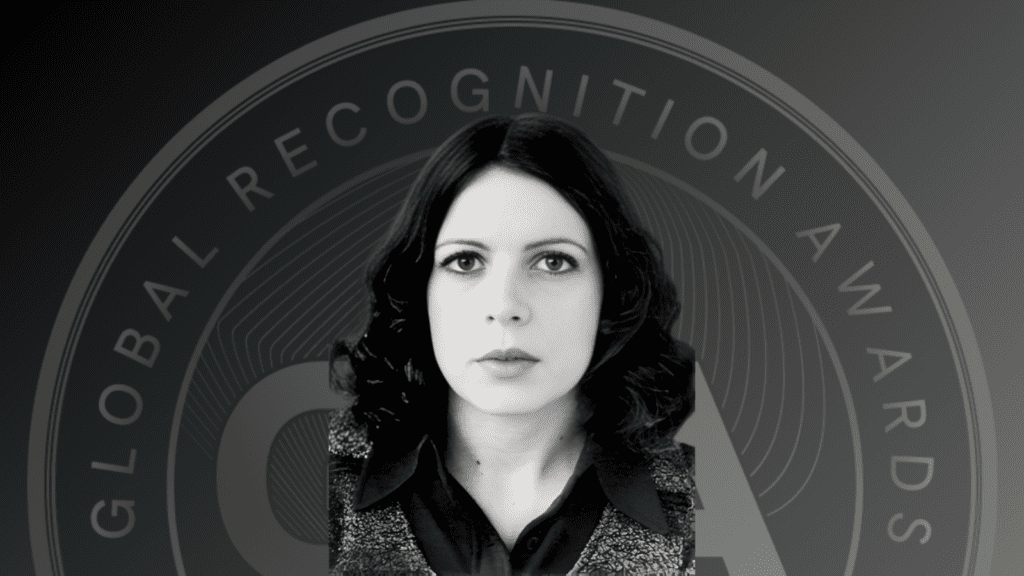
Vera Simone Nova Receives 2026 Global Recognition Award™
Vera Simone Nova has been recognized with a 2026 Global Recognition Award for her decades of independent, cross-disciplinary research into human perception and cognition, a body of work that challenges foundational assumptions about how the mind processes reality and what that means for the future of human intelligence, artificial systems, and education. Nova’s research draws on philosophy, cognitive science, and artistic expression to construct a framework that treats perception not as a passive recording of the world but as an active, creative process shaped by universal laws she identifies as Flux and Limitations. These laws, she contends, govern all of existence and explain why human beings are constitutionally incapable of perceiving anything as it truly is, a claim with far-reaching consequences for education, technology, and the design of modern institutions. Central to her thinking is the recognition that the greatest gift granted to every living being by nature is the natural mechanism of perception, entirely unique to each individual and unlimitedly creative at its core.
Global Recognition Awards evaluates nominees through a rigorous, multi-stage process, beginning with an initial screening based on eligibility criteria that include industry recognition, innovation, leadership, service, sustainability, and social responsibility, conducted by a panel of experts selected for their domain knowledge and impartiality. Shortlisted nominees are then evaluated using the Rasch model, which constructs a linear measurement scale across categories, allowing for precise comparisons between candidates who may excel in entirely different areas. Nova scored at the highest level, a 5, across every evaluated dimension, including originality of research methodology, interdisciplinary scope, real-world application, novelty of innovation, disruption of existing paradigms, and artistic accomplishment.
A Body of Work That Resists Easy Categories
Nova’s published works across genres and disciplines make her difficult to classify, which is precisely the point of her intellectual project. Her book “An Artist’s Notes on Humans and the Universe,” recommended by the U.S. Review of Books and reviewed by critic Peter M. Fitzpatrick, presents a layered model of the living mind, comprising three distinct levels: a superconscious, a cosmic, and a conscious layer, each operating under different constraints and capacities. Fitzpatrick noted that Nova’s framework challenges readers to reconsider what objectivity means and whether it is ever truly achievable, a question she pursues with philosophical rigor and artistic clarity. This line of inquiry is reinforced by one of her core positions: that no mind can fly outside its own self to observe the world as it truly exists “out there,” a constraint that shapes everything from individual cognition to the design of collective institutions.
Her philosophical novel “The Noble Society of Bullford,” published in 2018 and translated into French by L’Harmattan with a translation by Stephane Normand, extends her ideas into fiction to examine the limits of human social systems and the dangers of imposed ideals. Described by Archway Publishing, a Simon and Schuster imprint, as a work rooted in the Greek philosophical tradition, the book uses allegory to interrogate assumptions about ethics, governance, and human nature that most readers take for granted. French literary critic Dan Burcea, writing for the journal Lettres Capitales, called it a brilliant intellectual and artistic achievement, noting that its central ethical inversion, the argument that one should never treat others as one wishes to be treated unless they agree to it first, reflects Nova’s broader claim that universalized assumptions consistently fail to account for individual difference and natural variation. Running through this argument is a conviction she states plainly: “freedom minus responsibility equals madness, a principle she treats not as a moral slogan but as a structural truth about how human systems succeed or collapse.”
Research That Reframes Artificial Intelligence
Nova’s 2025 work, “Artificial Intelligence Versus Living Mind Intelligence,” published by Barnes and Noble, arrives at a moment when debates about the capabilities and risks of AI have intensified across academic, corporate, and policy circles, and Nova’s argument addresses that noise with a direct, substantiated claim. Artificial systems, no matter how sophisticated, are built on abstraction and simulation. Living intelligence is grounded in perception, instinct, and genuine awareness, a distinction that Nova argues modern technologists have consistently failed to make. She does not dismiss AI as useless, but she frames it as a compensatory device that substitutes for, rather than augments, the natural capacities of the human mind, capacities that are weakened when society becomes overly dependent on digital abstraction.
The book challenges technologists and educators alike to reconsider what they are optimizing for, drawing a sharp distinction between mimetic and creative talent, arguing that AI is capable only of the former. Nova’s framework, built over decades of independent research, suggests that societies overinvesting in digital systems risk dismantling the very cognitive capacities they believe technology is enhancing. These arguments connect directly to ongoing debates in neuroscience, philosophy of mind, and educational theory, and they are presented with the rigor of a researcher who has spent a lifetime building toward this conclusion, not a commentator reacting to a current trend.
Final Words
Nova’s work through the Nova Society Forum and Nova Society University further extends her reach beyond publishing, positioning these platforms as vehicles for a fundamental revision of educational practice that moves beyond the recycling of existing knowledge and toward a more rigorous engagement with the natural laws that govern human thought and experience. Among her workable plans is the development of a futuristic, non-robotic living town designed to grow organically around an advanced school and public forum, a community built on the premise that genuine human intelligence, not digital simulation, should anchor the way people live, learn, and govern themselves. She has built these institutions around the premise that most existing educational systems are constructed on incomplete or flawed assumptions about how the human mind actually works, assumptions that Nova’s research directly challenges and seeks to correct. Her ambition is not modest: it calls for a restructuring of how knowledge is taught, transmitted, and valued, starting from first principles rather than inherited conventions.
Vera Simone Nova represents the kind of thinker that the Global Recognition Awards exists to identify: someone operating outside institutional structures, driven by a decades-long commitment to a question that most of the academy has not yet caught up with. Alex Sterling, a spokesperson for Global Recognition Awards, stated, “Vera Simone Nova’s extraordinary ability to bring together philosophy, cognitive science, and artistic expression into a coherent and actionable framework for understanding the human mind is precisely the kind of world-class contribution this award was created to honor.” Nova’s recognition is a signal that original, independent research, pursued with discipline and intellectual honesty, still carries weight in a world increasingly dominated by institutional credentialing and algorithmic thinking.
ADDITIONAL INFORMATION
| Table Header | Table Header |
|---|---|
|
Industry |
Academic Research and Independent Philosophy |
|
Location |
Pahrump, NV, USA |
|
What They Do |
Vera Simone Nova is an independent researcher, author, and artist whose work focuses on human perception and cognition. Drawing on Greek philosophy, particularly the ideas of Heraclitus and Protagoras, she argues that the human mind cannot perceive reality as it truly is, governed by universal laws she calls Flux and Limitations. She has published several books exploring these ideas, including “An Artist’s Notes on Humans and the Universe” and “Artificial Intelligence Versus Living Mind Intelligence,” the latter examining the fundamental differences between machine processing and human thought. She also runs the Nova Society Forum and Nova Society University, platforms dedicated to educational reform. |
|
Website |
Take your business to the next level
Apply today and be a winner