
WINNER 2026
Spectrum Plasma Celebrates 2026 Global Recognition Award™

Spectrum Plasma Receives 2026 Global Recognition Award™
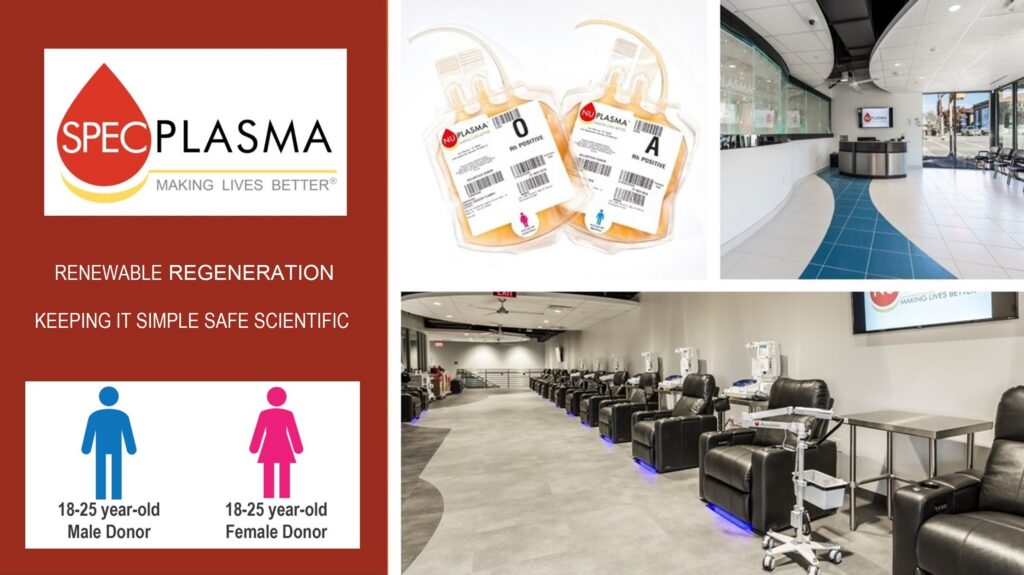
Spectrum Plasma has been recognized with a 2026 Global Recognition Award for developing age- and sex-specific plasma collection that addresses one of healthcare’s most pressing challenges: the rising costs and prevalence of chronic diseases in aging populations. The company operates as the only fully accredited blood bank worldwide to collect plasma exclusively from donors aged 18-25. It maintains rigorous identification protocols based on age and biological sex. This achievement reflects exceptional innovation in a field where the infrastructure exists, but the differentiation strategy represents a fundamental paradigm shift in regenerative medicine.
Human studies demonstrate that transfusing young plasma into sex- and blood-type-matched older recipients triggers immediate cellular responses, with proteins most strongly associated with aging changing significantly based on sex compatibility. Spectrum Plasma’s approach converts plasma from a generic medical resource into a precisely targeted therapeutic intervention that operates within existing distribution and administration infrastructure. The company requires only leadership and education to implement what it terms renewable regeneration programs across communities worldwide, given that research shows plasma from young donors introduces approximately 10,000 proteins, 5,000 peptides, 45 cytokines, 50 sex-matched hormones, and 1.84 billion exosomes per milliliter.
Global Recognition Awards evaluated Spectrum Plasma using the Rasch model, which creates a linear measurement scale allowing precise comparisons between applicants excelling in different areas. The company earned a grade of 5 exceptional or world-class across six innovation categories: novelty and originality, market impact, technological advancement, addressing global challenges, adoption rate and user feedback, and disruption of existing paradigms. These maximum scores reflect measurable achievements in a sector where 90 percent of the nation’s $5 trillion in annual healthcare expenditures are spent on chronic conditions, while people 55 and older account for 56 percent of total health spending despite representing only 30 percent of the population.
Disrupting Healthcare Economics Through Donor Demographics
Spectrum Plasma’s core innovation does not depend on new technology but instead recognizes an overlooked variable that fundamentally changes therapeutic outcomes: donor age and sex identification. Young donors already supply 20 percent of the blood supply, yet, until Spectrum Plasma established its protocols, their donations remained indistinguishable from those of older donors in clinical settings where specificity could have yielded superior results. Research conducted at Stanford demonstrated that infusing young plasma into elderly recipients produces measurable regenerative effects across all cells in older bodies, restoring function comparable to that of younger physiological states and reversing markers of biological decline.
Children of elderly clinical trial participants observed parents with dementia becoming more engaged, energetic, and communicative. Some families resumed outings due to improved lucidity that had been absent for years. Clinical evidence shows that a 67-year-old male with Parkinson’s disease who received 2.5 liters of young, fresh-frozen plasma through three exchanges within 30 days experienced an 18% reduction in his DunedinPACE score within 4 months, indicating measurable deceleration of biological aging. Spectrum Plasma’s donor screening ensures blood protein levels between 6-9 g/dL and normal protein fractions, protecting donors during apheresis and ensuring recipients receive optimal protein profiles that older donor plasma cannot provide.
Scaling Impact Through Existing Infrastructure
Spectrum Plasma operates at an international scale by leveraging century-old plasma collection and distribution systems while introducing age- and sex-specific protocols that enhance therapeutic value without requiring new facilities or equipment. The company’s accreditation as a registered blood bank provides regulatory legitimacy in a field where safety standards remain paramount. Its focus on young donors creates a differentiated product that commands premium positioning. Every donor undergoes screening for viral markers, including HIV, hepatitis B and C, and other pathogens. All units remain held for quality release before infusion occurs.
The apheresis process Spectrum Plasma employs allows for more frequent donations than whole blood collection, as plasma volume is regenerated within 24-48 hours, creating supply chain advantages while providing health benefits to young donors through detoxification. Spectrum Plasma’s inventory management ensures sex-matched hormones and age-appropriate protein profiles reach recipients, creating a level of precision previously absent from plasma therapeutics that relied on pooled donations from mixed-age populations. The company’s model demonstrates how existing medical infrastructure can generate significant outcomes through strategic differentiation rather than capital-intensive technological development, proving that innovation sometimes requires rethinking protocols rather than inventing devices.
Final Words
Spectrum Plasma’s recognition reflects its success in translating scientific insights into operational reality while addressing a market gap that larger blood banks have overlooked, despite decades of research supporting age-specific benefits. The company identified that proteins like GDF11, abundant in young blood but depleted in older individuals, represent therapeutic opportunities that require only systematic collection and distribution protocols that preserve donor demographics throughout the supply chain. Research continues to validate plasma transfusion safety and efficacy, with minimal adverse events reported, and ongoing studies are expected to be completed in 2026, further documenting neurological and systemic benefits that extend beyond current clinical applications.
Thomas Casey and Spectrum Plasma demonstrate how precision targeting within established systems can address global health challenges more effectively than many high-tech interventions, which require extensive development cycles and regulatory approval. “Spectrum Plasma has shown exceptional ability to translate regenerative medicine research into accessible treatments that benefit young donors and aging recipients, creating a sustainable model for community health that operates within existing infrastructure while delivering measurably superior outcomes,” noted Alex Sterling, spokesperson for Global Recognition Awards. The company’s exclusive focus on young, sex-identified donors positions it to meet the growing demand for age-appropriate plasma therapeutics while maintaining the safety standards and operational efficiency that earned it a place among 2026’s most innovative healthcare organizations.
ADDITIONAL INFORMATION
| Table Header | Table Header |
|---|---|
|
Industry |
Blood Banking |
|
Location |
San Marcos, TX, USA |
|
What They Do |
Spectrum Plasma operates as the only fully accredited blood bank worldwide that collects plasma exclusively from donors aged 18-25. The company maintains rigorous protocols based on donor age and biological sex, converting plasma from a generic medical resource into a precisely targeted therapeutic intervention. Research demonstrates that transfusing young plasma into age- and sex-matched older recipients triggers immediate cellular responses and reverses markers of biological aging. The company screens donors for viral markers and holds all units before release. This approach addresses chronic diseases in aging populations by leveraging existing plasma collection infrastructure while introducing age-specific and sex-specific differentiation. |
|
Website |
Take your business to the next level
Apply today and be a winner